

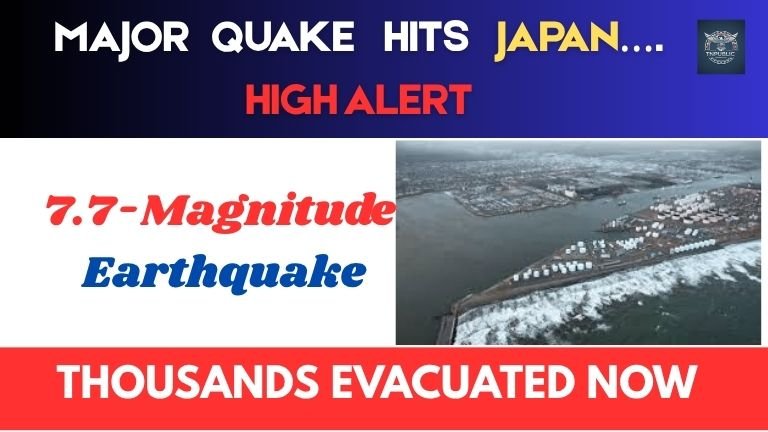
Japan 7.7 Earthquake Shakes Northern Coast — Tsunami Warning Issued, Thousands Evacuated
A powerful earthquake off the northern coast of Japan sent shockwaves through the region — and through global news feeds — raising fears of a much larger disaster to come.
On Monday, a 7.7-magnitude earthquake struck off Japan’s northern coast, triggering immediate tsunami warnings. Tens of thousands of people were ordered to move to higher ground. Coastal residents were told to stay away from the sea. Within hours, waves of up to 2.5 feet hit shorelines — far below the feared 10-foot waves — and no major injuries or damage were confirmed.
But the bigger worry? Japan’s Meteorological Agency quietly issued an advisory warning of a “slightly increased risk” of a mega-quake in the days ahead. That single line alarmed seismologists around the world.
Here is everything you need to know — clearly and simply.
What Happened: The 7.7-Magnitude Earthquake Explained
Japan’s Meteorological Agency confirmed the quake measured at magnitude 7.7, placing its epicenter off the northern Japanese coastline. It struck with enough force to immediately trigger automated tsunami warning systems across the region.
Within minutes of the quake, sirens were blaring in coastal towns. Evacuation orders went out to tens of thousands of residents. Emergency services were activated. People grabbed their go-bags and headed inland.
This was not a drill.
The quake is considered one of the strongest to hit Japan in recent years. For context, Japan sits on the “Ring of Fire” — the most seismically active zone on the planet — and experiences hundreds of earthquakes every year. But a 7.7 is serious by any standard.
Tsunami Warning: What Actually Happened at the Coast
After the quake, Japan issued a formal tsunami warning — not just a watch or advisory, but an actual warning.
Authorities warned that waves could reach heights of up to 10 feet (about 3 metres). That level would cause significant coastal flooding and destruction.
In reality, the recorded waves reached approximately 2.5 feet at the highest points. No significant flooding, injuries, or deaths were reported as of the latest updates.
This outcome — frightening warning, lower actual impact — is not uncommon. Tsunami forecasts are intentionally cautious. It is always better to evacuate unnecessarily than to stay and face a deadly wave.
The evacuation orders were credited with keeping people safe.
The Mega-Quake Advisory: What Does It Mean?
This is the part that has scientists and the public paying close attention.
After the 7.7 quake, Japan’s Meteorological Agency issued a special advisory stating there was a slightly elevated risk of a mega-quake in Japan’s northern regions over the coming days.
Normally, the probability of a mega-quake occurring on any given day is extremely low — roughly 0.1%. After Monday’s earthquake, that probability rose to approximately 1%.
That is a tenfold increase. And while 1% sounds small, in earthquake science, it is significant enough to warrant official warnings.
What Is a “Mega-Quake”?
A mega-quake is generally defined as an earthquake of magnitude 8.0 or higher. At that scale, the destruction can be catastrophic — capable of triggering large tsunamis, collapsing buildings, and affecting entire regions.
Japan experienced one of the most devastating mega-quakes in recorded history in March 2011, when a 9.0-magnitude earthquake triggered the Fukushima nuclear disaster and killed nearly 20,000 people.
The memory of that event makes every advisory like this one deeply serious for the Japanese public.
Nuclear Plants: Are They Safe?
One of the first questions after any major earthquake in Japan is always: what about the nuclear plants?
Following Monday’s quake, operators confirmed that no abnormalities were found at the Fukushima Daiichi and Fukushima Daini nuclear power plants, as well as other facilities in the region.
The United Nations nuclear watchdog — the International Atomic Energy Agency (IAEA) — also confirmed that it had been informed by Japan of no abnormalities at any nuclear facility.
This is reassuring news, though monitoring will continue in the days ahead given the elevated mega-quake advisory.
What About Other Countries? Is There a Wider Tsunami Risk?
For people outside Japan watching this news, the question is: could this affect us?
The U.S. National Tsunami Warning Center confirmed clearly that there is no tsunami threat to the following regions:
- California
- Oregon
- Washington
- Alaska
- British Columbia, Canada
This means the Pacific Ocean did not experience a large enough wave-generating event to endanger North American coastlines.
India, being in the Indian Ocean, is also not in the direct path of any tsunami generated by this event.
Evacuation Orders: How Japan Responded So Quickly
Japan’s response to this earthquake demonstrated why the country is considered the global leader in disaster preparedness.
Within minutes of the quake:
- Automated alerts were sent to mobile phones across the affected region
- Tsunami sirens sounded along the coastline
- Evacuation orders were issued to tens of thousands of residents
- Emergency broadcasts interrupted all television and radio
Japan has invested decades and billions of yen into its early warning infrastructure. The country runs regular earthquake and tsunami drills at schools, offices, and community centres. This culture of preparedness saves lives every time a quake strikes.
Common Questions and Obstacles: What People Are Searching Right Now
1. Is Japan safe to visit right now?
Japan remains open, and the government has not issued any blanket travel restrictions. The affected coastal areas are under close monitoring. Travellers should check advisories from their home country’s foreign affairs ministry before travelling to northern Japan specifically.
2. How often does Japan have major earthquakes?
Japan experiences thousands of earthquakes every year. Most are minor and unfelt. However, quakes above magnitude 6.0 are not rare. The country’s strict building codes and early warning systems are specifically designed to handle frequent seismic activity.
3. Why does Japan get so many earthquakes?
Japan sits at the intersection of four major tectonic plates: the Pacific Plate, the Philippine Sea Plate, the Eurasian Plate, and the North American Plate. The constant movement and collision of these plates creates intense seismic activity beneath Japan.
Expert Analysis: What Seismologists Are Watching
Seismologists are closely monitoring the aftershock sequence following Monday’s quake. Large earthquakes are often followed by a series of smaller aftershocks — but occasionally, a large foreshock precedes an even bigger event.
The 1% mega-quake probability cited by Japan’s Meteorological Agency is based on statistical models that analyse foreshock-mainshock patterns. Scientists are watching for unusual clustering of aftershocks, any change in the direction or depth of seismic activity, and GPS data showing ground deformation.
The advisory does not mean a mega-quake is certain or even likely. It means the risk is elevated enough that authorities want people to remain alert and prepared.
Japan’s disaster management agencies have advised all residents in northern coastal prefectures to keep emergency kits ready, stay informed through official channels, and avoid unnecessary time near beaches or low-lying coastal areas.
Key Facts at a Glance
- Earthquake magnitude: 7.7
- Location: Off northern Japan’s coast
- Tsunami warning issued: Yes
- Waves recorded: Up to 2.5 feet (feared up to 10 feet)
- Injuries or deaths: None reported
- Nuclear plants affected: No abnormalities reported
- Mega-quake risk: Elevated to 1% (normal: 0.1%)
- U.S. coastal tsunami risk: None
6. FAQs
Q1: How serious is a 7.7-magnitude earthquake? A magnitude 7.7 earthquake is classified as a “major” earthquake on the Richter scale. It is powerful enough to cause serious damage to buildings, trigger tsunamis, and result in significant casualties if it strikes a populated area. In this case, the quake’s offshore location reduced the direct impact on land. However, it was strong enough to generate a tsunami warning across the region.
Q2: What is the difference between a tsunami warning and a tsunami watch? A tsunami warning means a tsunami has been detected or is imminent, and people in coastal areas must evacuate immediately. A tsunami watch means conditions are right for a tsunami to develop, and people should be ready to move. A warning is more urgent and requires immediate action. Japan issued a full warning after Monday’s quake, not just a watch.
Q3: Could the mega-quake advisory affect India? India is not directly in the seismic zone affected by this advisory. Japan’s northern region mega-quake risk is specific to the Pacific tectonic environment. However, if an exceptionally large quake — above magnitude 9.0 — were to occur, it could potentially generate Pacific-wide tsunami waves. The current risk level does not indicate such an event is imminent or expected.
Q4: Why did the tsunami waves end up being smaller than predicted? Tsunami forecasting is a conservative science by design. Agencies issue worst-case estimates to ensure public safety. The actual wave height depends on many factors, including the exact depth, location, and fault movement of the earthquake. In Monday’s case, the quake’s characteristics produced smaller waves than the upper-end forecast, which was a relief. The evacuation orders were still the right call.
Q5: What should someone in Japan do during the current elevated mega-quake advisory? People in northern Japan should keep their emergency kits fully stocked with water, food, medicines, and important documents. They should know their nearest evacuation routes and designated shelters. Avoid spending time near beaches or ports. Keep mobile phones charged and notifications turned on for official alerts. Follow instructions from local government and avoid spreading unverified information on social media.
| Apply link |
Read more:- https://tnpublic.in/the-fastest-wordpress-theme/#more-21
external link:- https://www.thehindu.com/